Is an Indian Passport Enough to Prove Citizenship?
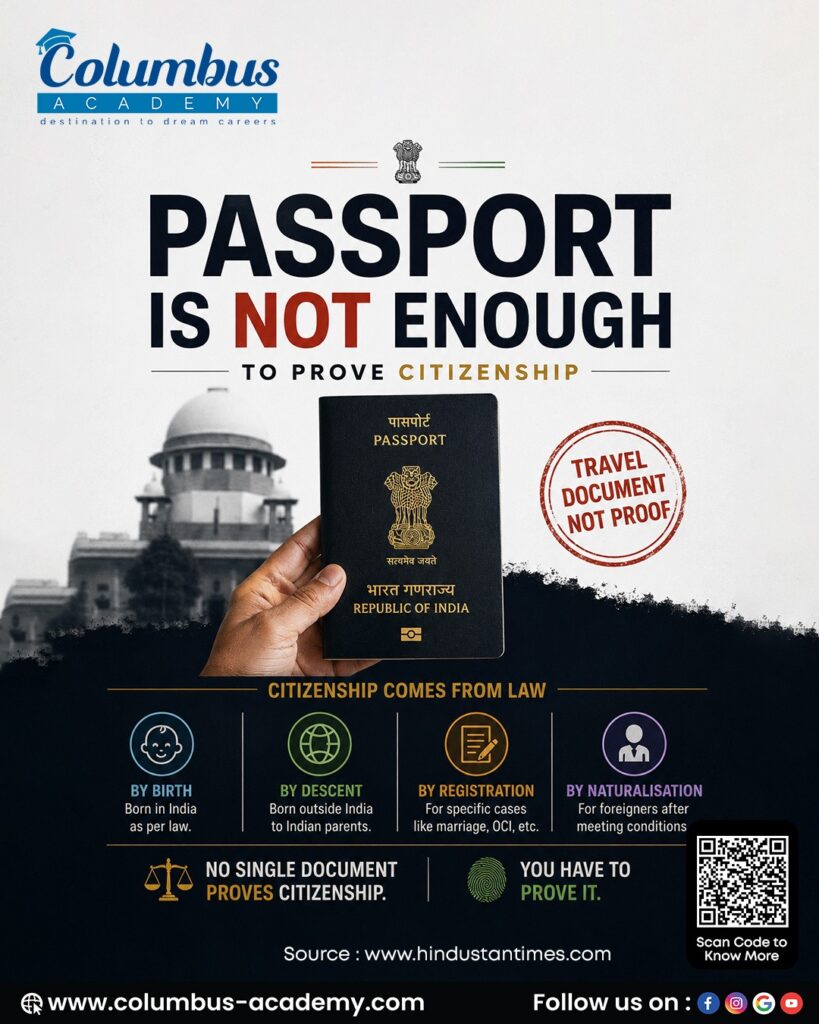
Recently, a statement by the Ministry of External Affairs (MEA) sparked widespread discussion across social media. The clarification stated that an Indian passport is primarily a travel document and, by itself, is not considered conclusive proof of Indian citizenship under the law. This led many people to question the actual role of a passport and how citizenship is legally determined in India.
A passport is an official document issued by the Government of India that allows citizens to travel internationally. While it is issued after a detailed verification process, Indian law does not recognize it as the sole and final proof of citizenship in every legal situation.
It is important to understand the difference between identity proof and citizenship proof. Documents such as Aadhaar Card, PAN Card, and Voter ID primarily establish a person’s identity or place of residence. However, citizenship is determined according to the provisions of the Citizenship Act, 1955.
Under Indian law, citizenship can be acquired through four major routes:
- By Birth – Individuals born in India under specified legal conditions.
- By Descent – Individuals born outside India to Indian parents.
- By Registration – Certain categories of people, such as persons of Indian origin or spouses of Indian citizens.
- By Naturalisation – Foreign nationals who fulfill prescribed conditions and reside in India for a specified period.
For most Indians, citizenship is established through a combination of government records, birth records, family documents, and other legal evidence rather than through a single document.
The recent clarification from the MEA does not diminish the importance of a passport. Instead, it highlights the legal distinction between a travel document and citizenship under Indian law. Understanding these distinctions helps citizens stay informed and avoid misinformation in an increasingly digital world.